
Reflections
100-Point Pétrus Vintages: 1989, 1998, 2009, 2010, 2016 & 2020

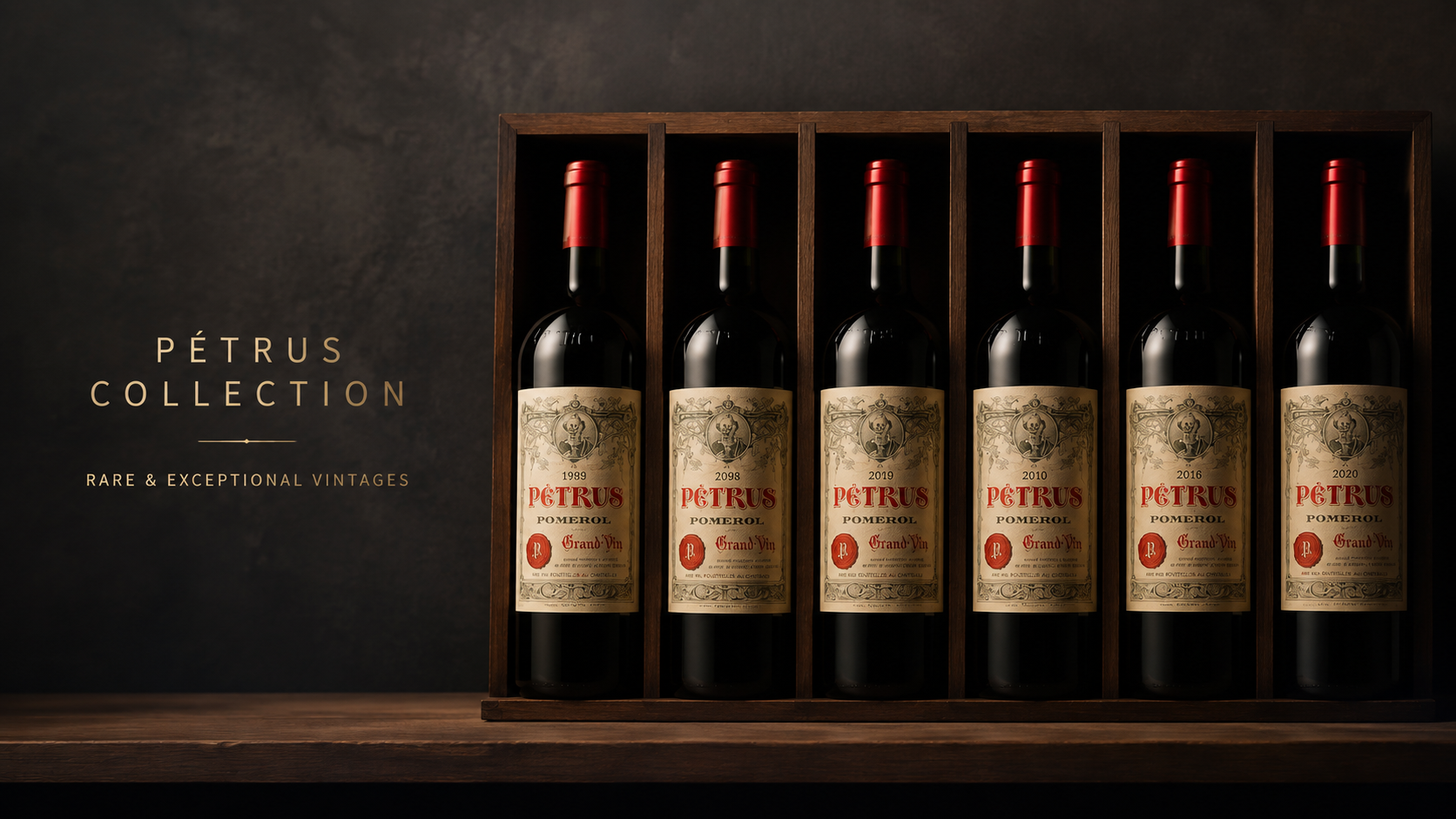
Which Pétrus Vintages Scored 100 Points? 1989, 1998, 2009, 2010, 2016 & 2020
Six bottles. More than three decades of Pomerol. One thing in common: the 1989, 1998, 2009, 2010, 2016 and 2020 Pétrus have each received a perfect 100-point score from The Wine Advocate.
They did not get there in the same way.
The 1989 Pétrus is a mature benchmark. The 1998 was reassessed decades later and elevated to a perfect score. The 2009 and 2010 show two strikingly different expressions from consecutive great Bordeaux vintages, while 2016 and 2020 represent a younger, highly precise generation of Pétrus.
Rare Collects has brought these six vintages together as a curated collection for collectors who want to experience Pétrus across more than 30 years.
View the 100-Point Pétrus Collection and Pétrus Vertical Sets at Rare Collects.
This is not intended to be a complete list of every Pétrus vintage ever awarded a perfect score. Other historic Pétrus vintages have also earned 100-point ratings.
This is the story of six perfect-score Pétrus wines assembled together at Rare Collects.
What Is Pétrus?
Pétrus is one of the most sought-after wines in Bordeaux.
It comes from Pomerol on Bordeaux's Right Bank, where Merlot reaches a level of richness, texture and longevity that has made the estate a reference point for collectors around the world.
Unlike Château Lafite Rothschild, Château Latour or Château Margaux, Pétrus is not a First Growth.
In fact, Pomerol was never included in Bordeaux's famous 1855 Classification.
That has never stopped Pétrus from becoming one of the most valuable and prestigious wines produced anywhere in Bordeaux.
Its reputation comes from the vineyard, tiny production, extraordinary consistency and the distinctive character of its terroir.
What Makes Pétrus Different From Other Bordeaux Wines?
Pétrus comes from a relatively small vineyard on the Pomerol plateau.
The estate is particularly famous for its dense blue clay soils, which are closely associated with the structure, richness and distinctive texture of the wine.
Modern Pétrus is produced from Merlot.
That sounds simple until you taste mature Pétrus.
At its best, the wine can move from ripe plum, blackberry and black cherry into violet, truffle, earth, tobacco, spice and deep mineral notes as it ages.
Pétrus can be immensely powerful without relying on sheer weight.
That balance is part of its identity.
Why Is Pétrus So Rare?
Production is tiny compared with many famous Bordeaux estates.
Global demand is not.
That creates a simple problem for collectors: there are far more people who want Pétrus than there are bottles available.
The situation becomes even more difficult with older vintages.
Every year, bottles are opened.
Others disappear into long-term private collections.
Some are damaged through poor storage.
And no winery can ever produce another bottle of 1989, 1998 or 2009 Pétrus.
The available supply only gets smaller.
What Does a 100-Point Pétrus Score Mean?
A 100-point rating is a critic's assessment of a wine.
It is not an official Bordeaux classification, and a score does not change the legal status of the wine.
But a perfect score from a major publication such as The Wine Advocate carries significant weight in the fine-wine market.
For an already scarce wine like Pétrus, a 100-point score can bring even more attention to one specific vintage.
Collectors may begin hunting that year specifically.
And that is an important point about this six-bottle collection.
Not every perfect score discussed here was personally awarded by Robert Parker.
The Wine Advocate continued with other critics after Parker, and several Pétrus vintages have been reassessed as they matured.
The 1998 is the clearest example.
1989 Pétrus: A 100-Point Bordeaux Monument
The 1989 Pétrus is the oldest wine in this six-vintage collection.
It is also one of the benchmark Pétrus vintages of the modern era.
Robert Parker awarded the wine 100 points, recognizing its extraordinary concentration, structure and aging potential.
More than three decades later, the 1989 offers something the younger wines in this collection cannot reproduce:
maturity.
With age, great Pétrus can move beyond its primary fruit into a more complex spectrum of:
Black cherry
Plum
Truffle
Tobacco
Earth
Spice
Savory notes
Mineral character
A properly stored 1989 Pétrus gives the collector an opportunity to experience what decades of bottle evolution can do to one of Pomerol's greatest wines.
Why Is 1989 Pétrus So Collectible?
It combines three major factors:
A historically important Bordeaux vintage
A perfect critic score
More than three decades of bottle development
It is the mature anchor of this six-bottle collection.
1998 Pétrus: The Wine That Grew Into 100 Points
The 1998 Pétrus has one of the most interesting stories in the group.
Robert Parker originally rated the wine 98 points for The Wine Advocate.
That is already an exceptional score.
But wine does not stop developing after a critic publishes a review.
When Wine Advocate critic William Kelley revisited the 1998 more than two decades later, he awarded it a perfect 100 points.
That makes the 1998 a fascinating example of how serious wines can evolve.
A score is a snapshot. The wine keeps moving.
What Is 1998 Pétrus Like?
The 1998 vintage was particularly strong for Bordeaux's Right Bank.
Mature examples of Pétrus can show a compelling combination of:
Dark berries
Black cherry
Violet
Truffle
Licorice
Earth
Mineral character
Silky tannins
The wine has had decades to integrate and develop.
That is fundamentally different from tasting a young Pétrus immediately after release.
Why Is the 1998 Pétrus Important?
Because its critical history illustrates something collectors sometimes forget.
Great wine can become more interesting with time, not simply older.
The 1998 wasn't suddenly transformed because two points were added to a score.
The wine evolved enough for a later critic to see it differently.
2009 Pétrus: The Opulent 100-Point Vintage
Then comes the 2009 Pétrus.
If one word defines the reputation of the vintage, it is:
opulence.
The 2009 received a perfect 100-point Wine Advocate score and became one of the standout wines from a famously rich Bordeaux vintage.
Expect a broad spectrum of ripe and expressive characteristics:
Plum
Mulberry
Black cherry
Red fruit
Rose
Licorice
Spice
Earth
The wine is powerful, but the fruit surrounding that structure gives it a particularly generous character.
What Makes the 2009 Pétrus Different?
It is expressive.
Rich.
Plush.
Seductive.
That does not mean the wine lacks structure.
It means the structure is wrapped in an unusually generous amount of fruit and texture.
2009 shows the opulent side of Pétrus.
2010 Pétrus: Structure, Depth and Long-Term Potential
The 2010 Pétrus arrived immediately after the extraordinary 2009 vintage.
It also earned a 100-point Wine Advocate rating.
Yet the two wines do not taste alike.
The 2010 is generally more structured, firm and classical in its personality.
That makes comparing the two one of the most interesting exercises in modern Pétrus.
2009 Pétrus vs. 2010 Pétrus
A simple way to understand the difference:
2009 Pétrus
Rich
Generous
Opulent
Plush
More immediately expressive
2010 Pétrus
Structured
Mineral
Firm
Precise
Built for long development
Neither description means one wine is objectively better.
They demonstrate how dramatically vintage conditions can change the character of wine from the same estate.
Why Own 2009 and 2010 Together?
Because this is exactly what makes a vertical interesting.
Same estate. Same vineyard. Consecutive vintages. Different personalities.
That comparison is far more informative than simply owning two famous bottles.
2016 Pétrus: Precision Meets Power
The 2016 Pétrus also earned a perfect 100-point Wine Advocate rating.
Compared with 2009 and 2010, the 2016 offers another expression of the estate.
There is plenty of concentration, but the wine is also defined by freshness, detail and precision.
Its aromatic profile can move through:
Black plum
Cherry
Blueberry
Violet
Rose
Licorice
Dark chocolate
Spice
Mineral notes
What Makes 2016 Pétrus Special?
Precision.
The wine has power without feeling simply massive.
It is structured, youthful and built for significant cellar time.
That creates an interesting comparison with the oldest wine in this collection.
The 1989 demonstrates what decades of maturity can produce.
The 2016 still shows much more of the architecture underneath.
One shows where Pétrus has been. The other shows where it may be going.
2020 Pétrus: A Modern 100-Point Benchmark
The youngest wine in the collection is the 2020 Pétrus.
Wine Advocate critic William Kelley awarded the vintage a perfect 100 points.
Unlike the 1989 or 1998, the 2020 is still at the beginning of its evolution.
That is exactly why it belongs here.
The wine combines concentration with refined tannins and strong freshness.
Expect a youthful profile around:
Dark berries
Cherry
Cassis
Violet
Exotic spice
Mineral character
Fine tannin
Long structure
Why Is 2020 Pétrus Important?
Because this collection is not simply a retrospective.
The 2020 gives the collector a young Pétrus that may have decades of development ahead of it.
Place it next to the 1989 and 31 years separate two perfect-score wines from the same estate.
That is a remarkable comparison.
How Do the Six 100-Point Pétrus Vintages Compare?
All six earned the same perfect number.
They do not show the same personality.
1989 Pétrus
Character: Powerful, structured and mature.
Best suited to someone interested in experiencing mature Pétrus with decades of bottle development.
1998 Pétrus
Character: Silky, precise and increasingly complex.
Its later elevation to a perfect Wine Advocate score makes the vintage particularly fascinating.
2009 Pétrus
Character: Rich, plush and opulent.
The most generous expression among these six.
2010 Pétrus
Character: Structured, mineral and classical.
A wine with formidable structure and long-term potential.
2016 Pétrus
Character: Powerful, fresh and precise.
A younger expression where concentration and clarity coexist.
2020 Pétrus
Character: Refined, youthful and deeply concentrated.
The youngest bottle in the group, with much of its evolution still ahead.
Which 100-Point Pétrus Vintage Is Best?
There is no useful single answer.
It depends on what you want from the wine.
For mature Pétrus: 1989
For mature complexity and precision: 1998
For opulence: 2009
For structure: 2010
For modern precision: 2016
For long-term cellar potential: 2020
Trying to rank them one through six misses the reason to have them together.
The collection is interesting because the wines are different.
Why Isn't 1990 Pétrus Included?
Knowledgeable Pétrus collectors may immediately ask about the 1990 vintage.
Yes, 1990 Pétrus has also received a perfect 100-point rating.
Other vintages outside this collection have earned perfect scores as well.
The six wines discussed here are specifically the vintages assembled in the Rare Collects collection:
1989
1998
2009
2010
2016
2020
So this article should not be interpreted as a complete historical list of every 100-point Pétrus ever produced.
It is a closer look at six perfect-score vintages currently brought together by Rare Collects.
What Is a Pétrus Vertical?
A wine vertical is a collection containing multiple vintages of the same wine.
Instead of comparing different producers, the collector follows one estate through different harvests.
That allows you to see how variables such as weather, bottle age and time in the cellar influence the same wine.
With Pétrus, a vertical can reveal differences in:
Fruit profile
Structure
Tannin
Aromatics
Vintage character
Maturity
Aging potential
Winemaking eras
One Pétrus tells you about one year.
A vertical tells you about the estate.
Why Collect Multiple Pétrus Vintages?
Serious wine collecting often becomes more interesting once you stop thinking only about individual bottles.
The question changes from:
“Do I own Pétrus?”
to:
“Which Pétrus vintages do I own?”
And eventually:
“Which vintage am I missing?”
Rare Collects has assembled curated Pétrus collections for clients who want to explore the estate across different vintages, including the six 100-point wines discussed here.
Explore the Rare Collects Pétrus Vertical Sets.
A vertical turns individual bottles into a timeline.
In this case, that timeline stretches from 1989 to 2020.
Why Are Pétrus Vertical Sets So Interesting?
Because the label remains familiar while almost everything else changes.
The vintage changes.
The wine's age changes.
The growing season changes.
The stage of maturity changes.
This allows a collector to compare Pétrus in a way that buying one isolated bottle cannot.
Imagine tasting:
1989 → 1998 → 2009 → 2010 → 2016 → 2020
You move from mature tertiary complexity into progressively younger and more structured expressions.
That is the value of the set.
Is a 100-Point Score Enough Reason to Buy Pétrus?
No.
A score is useful information.
It should not replace understanding the wine.
The 1998 demonstrates this perfectly.
It was already an extraordinary Pétrus when Robert Parker rated it 98 points.
The bottle did not become great only after another critic awarded it 100.
The score changed because the wine continued to develop.
Collectors should also consider:
Vintage
Maturity
Provenance
Bottle condition
Storage history
Personal taste
Format
Why the wine belongs in the collection
Buy the wine, not simply the number.
Does a 100-Point Score Make Pétrus a Better Investment?
A perfect rating can increase collector attention.
It does not guarantee that a bottle will rise in value.
Fine-wine pricing is influenced by:
Supply
Collector demand
Vintage reputation
Provenance
Condition
Storage
Bottle format
Critical reputation
Broader wine-market conditions
Pétrus already benefits from extreme scarcity and global demand.
A perfect score can make one particular vintage even more desirable, but it should never be treated as a guaranteed financial return.
Why Provenance Matters With Older Pétrus
At this level, the individual bottle matters.
Two bottles of 1989 Pétrus may have the exact same wine and vintage printed on the label.
They can still be completely different purchases.
Collectors should pay attention to:
Fill level
Capsule condition
Signs of seepage
Cork
Label condition
Storage history
Provenance
Bottle size
Original case when applicable
This matters more as wines age.
A mature Pétrus has spent decades outside the château.
You are buying that particular surviving bottle, not an abstract vintage.
Can You Drink These Pétrus Vintages Now?
Yes.
But they are at dramatically different stages.
1989 and 1998
These are the most obvious candidates for someone who wants to experience mature Pétrus.
They have already had decades to develop secondary and tertiary characteristics.
2009
The 2009 is entering a more approachable stage while retaining substantial structure.
Its generous style may make it especially compelling for someone who prefers richer Pétrus.
2010
The 2010 remains more structured.
It can certainly be opened, but its architecture suggests significant life ahead.
2016
Still young.
A bottle today will show far more youthful power and structure than a mature Pétrus from the 1980s or 1990s.
2020
Very young by serious Pétrus standards.
Opening one now gives you an opportunity to taste the wine closer to the beginning of its evolution.
There is no wrong choice.
The question is which stage of Pétrus you want to experience.
Where Can You Buy the Six 100-Point Pétrus Vintages?
Rare Collects has assembled the 1989, 1998, 2009, 2010, 2016 and 2020 Pétrus into a curated six-bottle collection.
Each bottle represents a different vintage and a different stage in the evolution of one of Pomerol's most celebrated wines.
Rather than searching for each bottle individually, collectors can view the collection alongside other curated Pétrus verticals through Rare Collects.
View the 100-Point Pétrus Collection and Rare Collects Vertical Sets.
Rare Collects also maintains additional back-vintage Pétrus inventory for collectors looking for individual years, larger formats or wines needed to complete an existing vertical.
If you are looking for a specific vintage, contact Rare Collects for current availability and sourcing.
Frequently Asked Questions About 100-Point Pétrus
Is 1989 Pétrus a 100-Point Wine?
Yes.
The 1989 Pétrus received a perfect 100-point rating from Robert Parker and remains one of the benchmark vintages of the estate's modern history.
Is 1998 Pétrus a 100-Point Wine?
Yes.
The 1998 was originally rated 98 points by Robert Parker.
When Wine Advocate critic William Kelley revisited the wine decades later, he awarded it 100 points.
Why Did 1998 Pétrus Increase to 100 Points?
Because critics can reassess wine as it ages.
A young wine and the same wine after more than 20 years of development can show very different levels of aromatic complexity, integration and maturity.
Is 2009 Pétrus 100 Points?
Yes.
The 2009 Pétrus received a perfect 100-point Wine Advocate rating and is particularly known for its richness, generosity and opulent style.
Is 2010 Pétrus 100 Points?
Yes.
The 2010 Pétrus also received a perfect 100-point Wine Advocate rating.
It is generally viewed as more structured and classical than the richer 2009.
Which Is Better: 2009 or 2010 Pétrus?
There is no objective answer.
2009 is generally more opulent and generous.
2010 is generally more structured and firm.
That contrast is exactly what makes owning both vintages interesting.
Is 2016 Pétrus a 100-Point Wine?
Yes.
The 2016 Pétrus earned a perfect 100-point Wine Advocate rating and is known for combining tremendous concentration with freshness and precision.
Is 2020 Pétrus 100 Points?
Yes.
The 2020 Pétrus received 100 points from Wine Advocate critic William Kelley.
It is the youngest wine in this six-bottle collection.
What Is the Best Pétrus Vintage?
There is no single best year for every collector.
Vintage preference depends on whether you want mature wine, richness, structure, precision or long-term cellar potential.
Among these six:
1989: mature power
1998: mature complexity
2009: opulence
2010: structure
2016: precision
2020: long-term potential
Is Pétrus a First Growth?
No.
Pétrus is located in Pomerol, which was not included in Bordeaux's 1855 Classification.
Its status comes from its own reputation rather than a First Growth designation.
Is Pétrus Made From Merlot?
Yes.
Modern Pétrus is produced from Merlot grown on the estate's distinctive Pomerol terroir.
Why Is Pétrus So Expensive?
Several factors overlap:
Small vineyard
Very limited production
Worldwide demand
Historical reputation
Long aging potential
Scarcity of mature vintages
Collector demand
Critical recognition
Older bottles become even more difficult to replace as surviving supply declines.
What Is a Pétrus Vertical Collection?
A Pétrus vertical contains multiple vintages of Pétrus.
The purpose is to follow the same estate across different years and stages of maturity.
View Rare Collects' curated Pétrus Vertical Sets.
Where Can I Buy Older Pétrus Vintages?
Rare Collects maintains a selection of back-vintage Pétrus and other collectible Bordeaux from its Miami location.
Collectors looking for a specific year, format or missing bottle can also contact Rare Collects for sourcing assistance.
The Bottom Line
A perfect score is easy to understand.
100 points.
What makes this six-bottle Pétrus collection interesting is everything behind that number.
The 1989 brings mature power and structure.
The 1998 demonstrates how a great wine can continue evolving until critics reassess what they thought they knew.
The 2009 delivers opulence.
The 2010 answers with structure.
The 2016 shows precision.
And the 2020 remains at the beginning of a journey that may continue for decades.
All six reached 100 points.
None of them reached the same place in exactly the same way.
That is why collecting Pétrus by vintage is more interesting than simply owning one bottle with the famous name on its label.
Six bottles become six snapshots of one remarkable Pomerol estate across 31 years of wine history.
For a collector, that is the real story.
Explore the 100-Point Pétrus Collection and Pétrus Vertical Sets at Rare Collects.
If you are searching for a specific Pétrus vintage or format, contact Rare Collects for current availability and sourcing.