
The Legendary History of Dom Pérignon: Birth of the World’s Most Iconic Champagne

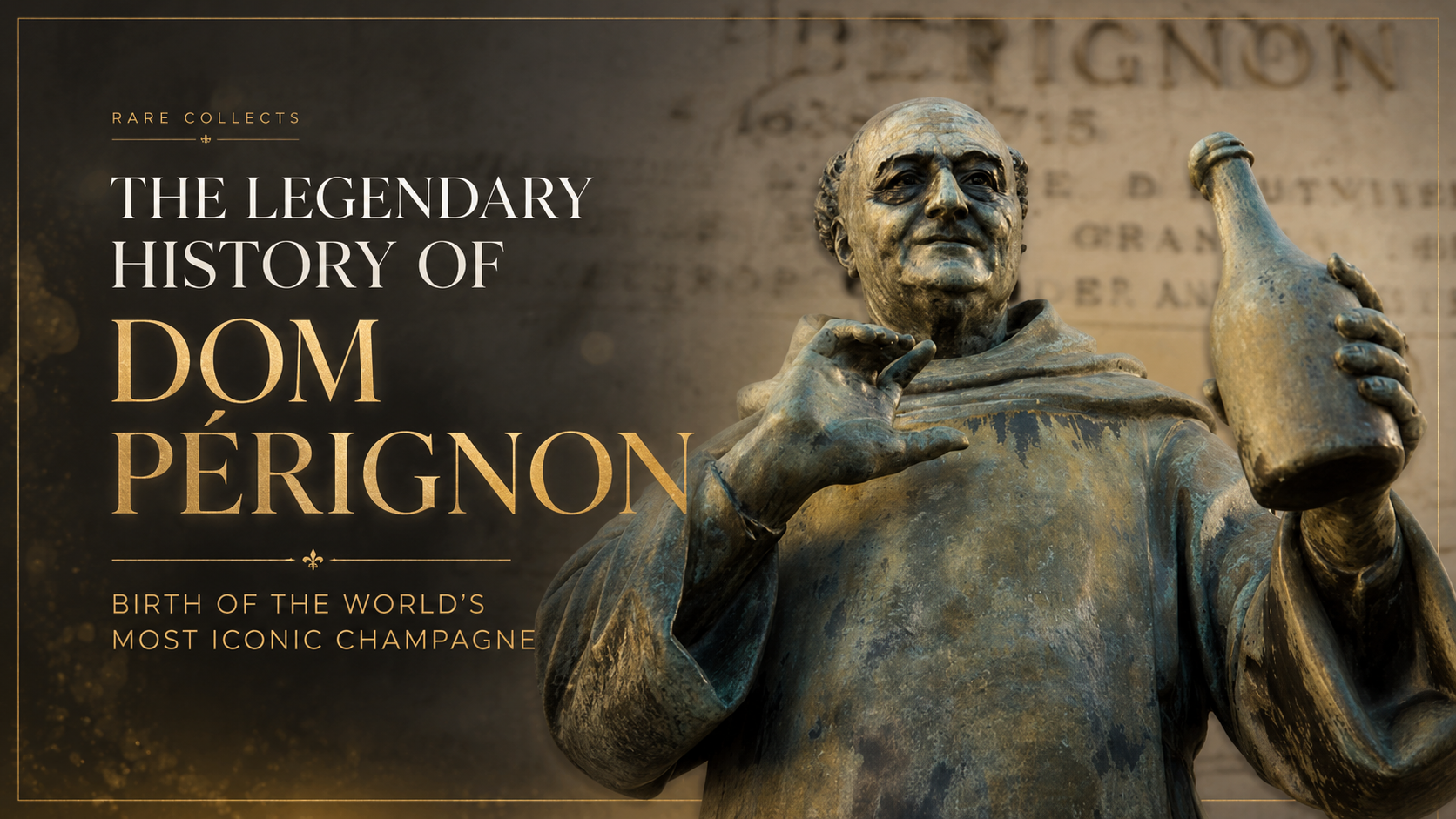
The Legendary History of Dom Pérignon: How a Monk’s Legacy Became the World’s Most Iconic Champagne
Dom Pérignon is one of the most recognizable names in Champagne, but the man behind the label never drank a bottle of Dom Pérignon as we know it today.
Dom Pierre Pérignon was a 17th-century Benedictine monk whose work at the Abbey of Hautvillers helped transform the quality of wines produced in Champagne. More than two centuries later, his name would be placed on a prestige Champagne that became synonymous with celebration, luxury and vintage wine.
The real history is more interesting than the legend.
Dom Pérignon did not simply “invent Champagne” one afternoon. His work was part of a much larger evolution in Champagne production, and his most important contribution was his relentless pursuit of better wine.
That philosophy still defines Dom Pérignon today.
Who Was Dom Pérignon?
Dom Pierre Pérignon was a French Benedictine monk born in 1638.
In 1668, he was appointed procurator at the historic Abbey of Hautvillers in Champagne. He would spend the next 47 years working with the abbey's vineyards and wines. LVMH, which today owns Dom Pérignon through Moët Hennessy, describes his ambition as an effort to create the “best wine in the world.”
That goal sounds surprisingly modern.
Pérignon was not merely making wine for immediate consumption. He was studying how fruit from different vineyards behaved, how wines could complement one another and how careful blending could produce something greater than the individual components.
This became one of his most important contributions.
Did Dom Pérignon Invent Champagne?
Not exactly.
The popular story that one monk suddenly discovered sparkling Champagne simplifies a much more complicated history.
The official Comité Champagne describes the period from roughly 1670 to 1720 as a turning point when sparkling wine production in Champagne gradually became deliberate rather than accidental. New developments in blending, pressing, bottles, closures and winemaking all contributed to the Champagne we recognize today.
Dom Pierre Pérignon was a major figure in that evolution, but not its sole inventor.
That distinction matters.
His greatest contribution was not discovering bubbles. It was helping establish a philosophy of precision, blending and quality that remains fundamental to great Champagne.
What Did Dom Pierre Pérignon Actually Do for Champagne?
Before Pérignon, blending wines from different vineyards could be relatively inconsistent.
He approached it differently.
The Comité Champagne credits him as one of the first people in the region to recognize that wines from different crus and different vineyards could complement one another when deliberately blended.
Instead of treating blending as a compromise, he treated it as a tool.
That idea is central to modern Dom Pérignon.
Even today, the Maison states that Dom Pérignon is always an assemblage — a blend — and that blending forms the foundation of its style.
Three centuries later, the philosophy remains remarkably consistent.
Why Is Hautvillers Important to Dom Pérignon?
To understand Dom Pérignon, you have to understand Hautvillers.
The hilltop village sits above the Marne Valley in Champagne and became one of the most important locations in the early development of the region's wines.
Dom Pierre Pérignon carried out his work at the Abbey of Hautvillers, and he remains closely connected to the village today.
His tomb can still be found inside the Church of Saint-Sindulphe in Hautvillers. The official Champagne tourism authority describes the village as one of the birthplaces of Champagne and recognizes Dom Pierre Pérignon's major role in its development.
For Champagne enthusiasts, Hautvillers is not simply where the story happened.
It is where the Dom Pérignon philosophy began.
When Did Dom Pérignon Champagne First Appear?
Here is where the monk and the Champagne brand become two separate stories.
Dom Pierre Pérignon died in 1715.
The Champagne carrying his name would not appear commercially until more than two centuries later.
The first Dom Pérignon vintage was 1921, and it was released commercially in 1936.
Christie's records the 1921 as the first vintage of the prestige cuvée and notes that 100 cases were shipped to New York in November 1936.
The timing was remarkable.
A monk who had died more than 200 years earlier was about to become the name behind one of the world's most recognizable luxury wines.
Why Was the First Dom Pérignon the 1921 Vintage?
Dom Pérignon was never designed to be ordinary Champagne.
The idea was to create a prestige wine based around an exceptional vintage and substantial cellar aging.
The 1921 harvest provided the wine for the first commercial release.
Rather than selling it immediately, the Champagne spent years developing before appearing on the market in 1936. Christie's identifies the 1921 as the first vintage of the prestige cuvée, while Sotheby's likewise records Dom Pérignon's first release as 1936 with the 1921 vintage.
That gap between harvest and release foreshadowed one of Dom Pérignon's defining characteristics:
time.
Why Is Dom Pérignon Always Vintage Champagne?
This is one of the most important things to understand about Dom Pérignon.
There is no non-vintage Dom Pérignon.
Every bottle represents grapes harvested during a single declared year.
LVMH states clearly that Dom Pérignon is vintage only. If a harvest does not provide what the winemaking team believes is necessary to express Dom Pérignon, the Maison can choose not to declare a vintage at all.
This is very different from many major Champagne bottlings.
Non-vintage Champagne allows producers to combine wines from multiple years to maintain a consistent house style.
Dom Pérignon accepts a different challenge.
The winemaking team must create the Dom Pérignon identity while simultaneously expressing the character of one specific harvest.
That tension is part of what makes vintage comparisons so interesting.
What Grapes Are Used to Make Dom Pérignon?
Dom Pérignon is fundamentally built around Chardonnay and Pinot Noir.
The exact proportions can change depending on the vintage because the objective is not to follow one rigid recipe year after year.
The objective is harmony.
That follows the philosophy established by Dom Pierre Pérignon centuries earlier: use blending deliberately rather than mechanically.
It is also why two Dom Pérignon vintages can taste remarkably different while still retaining a recognizable house character.
How Long Is Dom Pérignon Aged?
Longer than many people realize.
According to LVMH, a standard Dom Pérignon Vintage requires at least eight years of elaboration before reaching the desired balance. Dom Pérignon Rosé requires at least 12 years, while Plénitude 2 requires at least 15 years.
During that time, the Champagne develops in contact with its lees inside the cellar.
That extended maturation contributes to the texture, complexity and tertiary character associated with mature Dom Pérignon.
It also means that when you purchase a newly released Dom Pérignon, the vintage printed on the label may be many years behind the current calendar year.
That isn't old inventory.
The waiting is part of the wine.
What Is Dom Pérignon Plénitude?
One of the most fascinating parts of Dom Pérignon collecting is the concept of Plénitude.
Dom Pérignon believes its Champagne does not simply develop in one smooth, predictable line.
Instead, certain vintages reach periods where the wine enters another level of expression after extended maturation.
These moments are called Plénitudes.
Dom Pérignon Vintage
The familiar vintage release represents the first major expression of the wine after years of cellar maturation.
This is the Dom Pérignon most people know.
For example, Rare Collects carries bottles such as the 2015 Dom Pérignon Vintage Brut Champagne.
Dom Pérignon P2
P2 stands for Plénitude 2.
Rather than releasing the entire vintage at its first maturity, Dom Pérignon keeps a portion in its cellars for considerably longer maturation.
LVMH states that Plénitude 2 requires at least 15 years of elaboration.
The result is not simply an older bottle of regular Dom Pérignon.
It is a later release that has remained under the Maison's control through an extended period of maturation.
Collectors can see the difference through bottles such as the 2004 Dom Pérignon P2 Plénitude available through Rare Collects.
Dom Pérignon P3
Then there is Plénitude 3, or P3.
This is the extreme end of Dom Pérignon's philosophy of time.
Only mature vintages capable of reaching this advanced stage can become P3 releases, making them particularly interesting to Champagne collectors.
Rare Collects currently features examples such as the 1990 Dom Pérignon P3 Plénitude.
P3 is where Dom Pérignon stops feeling like simply a prestige Champagne and begins to resemble an archive of the Maison's history.
When Was Dom Pérignon Rosé Created?
The first Dom Pérignon Rosé vintage was 1959.
The official Dom Pérignon vintage library traces its Rosé history back to that year.
Rosé occupies a particularly important position within the Maison because producing great rosé Champagne requires a different balance of fruit, structure and maturity.
It also takes longer.
LVMH states that Dom Pérignon Rosé requires 12 years or more of elaboration.
For collectors, older Dom Pérignon Rosé can therefore represent a very different proposition from the regular Vintage release.
Rare Collects currently carries examples ranging from the 2005 Dom Pérignon Rosé to the large-format 2009 Dom Pérignon Rosé Luminous Magnum.
Why Are Some Dom Pérignon Vintages More Collectible Than Others?
A Dom Pérignon label alone does not make every bottle equally collectible.
Several factors matter.
-
Vintage quality
-
Age
-
Bottle condition
-
Provenance
-
Bottle size
-
Original packaging
-
Rosé versus Blanc
-
P2 or P3 designation
-
Special or limited-edition presentation
-
Scarcity of surviving bottles
The vintage itself is particularly important because Dom Pérignon is always vintage Champagne.
A collector is not simply buying “Dom Pérignon.”
They may be buying 1990 Dom Pérignon, 1996 Dom Pérignon, 2002 Dom Pérignon, or 2008 Dom Pérignon — each produced from a different growing season and showing a different stage of development.
That is why serious Champagne collections often include multiple vintages rather than multiple bottles from one year.
Why Are Dom Pérignon Magnums So Collectible?
Bottle format introduces another dimension.
A magnum contains 1.5 liters, equivalent to two standard 750ml bottles.
Large-format Champagne has obvious presentation value, but collectors also pay attention to it because the relationship between wine volume and oxygen inside the bottle differs from a standard bottle.
For older Champagne, this can make large formats particularly interesting.
Rare Collects, for example, offers a 1993 Dom Pérignon Vintage Brut 1.5L Magnum as well as younger large-format releases.
Move into Methuselahs and other oversized formats, and scarcity can increase considerably.
A dramatic example is the 2002 Dom Pérignon Rosé Luminous 6L Methuselah.
These bottles sit somewhere between wine, collector piece and centerpiece.
Why Did Dom Pérignon Become So Famous?
Dom Pérignon achieved something very few wine labels manage.
It became recognizable far beyond the wine world.
Part of that comes from history. Part comes from the distinctive shield-shaped label and bottle. Much of it comes from the strict vintage-only philosophy and decades of positioning at the highest end of Champagne.
But the wine also entered popular culture.
Dom Pérignon became shorthand for major celebrations, luxury hospitality, nightlife, gifting and milestone occasions.
The name became recognizable even to people who could not name another prestige cuvée.
That level of recognition is extraordinarily difficult for a wine producer to achieve.
Is Dom Pérignon Made by Moët & Chandon?
This question causes plenty of confusion.
Dom Pérignon is historically connected to Moët & Chandon and today sits within Moët Hennessy, the wines and spirits division of LVMH.
However, Dom Pérignon is positioned and produced as its own prestige Champagne identity rather than simply being a different label for Moët Impérial.
Think of the historical relationship as important, but do not assume that a bottle of Dom Pérignon is just aged Moët & Chandon.
Modern Dom Pérignon has its own winemaking philosophy, vintage declarations, maturation program and identity.
Is Dom Pérignon the Most Expensive Champagne?
No.
Dom Pérignon can become extremely expensive depending on vintage, format, age and release, but the standard Dom Pérignon Vintage is not automatically the world's most expensive Champagne.
That is an important distinction.
There are exceptionally rare Champagnes, historic vintages, large formats and special releases from Dom Pérignon and other producers that can command substantially higher prices.
The significance of Dom Pérignon is not that every bottle costs more than every competitor.
Its importance comes from the combination of history, worldwide recognition, vintage-only production and extraordinary longevity.
Does Dom Pérignon Get Better With Age?
A well-stored Dom Pérignon can develop significantly with bottle age.
Young vintage Champagne may emphasize citrus, white fruit, flowers, chalk and fresh brioche.
With time, mature bottles can develop deeper notes associated with toast, nuts, pastry, honey, dried fruit, spice and savory complexity.
But age is not automatically an improvement.
Storage matters tremendously.
For older Champagne, collectors should pay attention to:
-
Fill level
-
Cork and capsule condition
-
Signs of seepage
-
Label condition
-
Storage history
-
Provenance
-
Temperature exposure
A perfectly stored 30-year-old bottle and a poorly stored bottle from the same vintage can offer completely different experiences.
What Are the Best Dom Pérignon Vintages to Collect?
There is no single answer.
Collectors frequently look for celebrated vintages, birth-year bottles, anniversary years and releases that have developed strong reputations over time.
Other buyers specifically pursue P2, P3, Rosé or large-format bottles rather than standard 750ml Vintage releases.
A thoughtful Dom Pérignon collection might therefore contain:
-
Multiple vintages of Dom Pérignon Vintage
-
Dom Pérignon Rosé
-
P2 releases
-
P3 releases
-
Magnums
-
Methuselahs and other large formats
-
Special-edition bottles
-
Birth-year vintages
The important part is understanding what each bottle represents.
Where Can You Buy Rare and Vintage Dom Pérignon?
Current releases can often be found through established Champagne and fine-wine retailers.
Older vintages require more care.
Once bottles have spent decades outside the producer's cellar, condition and provenance become increasingly important.
Rare Collects Liquor & Wine specializes in rare wines and collectible Champagne, with Dom Pérignon ranging from current vintage releases through mature bottles, Rosé, P2, P3 and large formats.
Explore Dom Pérignon and collectible Champagne at Rare Collects Liquor & Wine.
Frequently Asked Questions About Dom Pérignon
Who was Dom Pérignon?
Dom Pierre Pérignon was a Benedictine monk who became procurator at the Abbey of Hautvillers in 1668.
He spent 47 years working to improve the abbey's wines and became particularly important for his deliberate approach to blending wines from different vineyards and crus.
Did Dom Pérignon invent Champagne?
No single person simply invented Champagne.
Dom Pierre Pérignon played an important role in improving wine quality and blending, but sparkling Champagne developed gradually through numerous winemaking and technological advances during the 17th, 18th and 19th centuries.
When was the first Dom Pérignon made?
The first Dom Pérignon vintage was 1921.
It was commercially released in 1936.
Is Dom Pérignon always vintage?
Yes.
Dom Pérignon is produced only as vintage Champagne, meaning the grapes in a particular release come from a single harvest year. The Maison may choose not to declare a vintage when the harvest does not meet its requirements.
How long does Dom Pérignon age before release?
LVMH states that Dom Pérignon Vintage requires at least eight years of elaboration, Rosé at least 12 years and Plénitude 2 at least 15 years.
What is Dom Pérignon P2?
P2 means Plénitude 2.
It represents a Dom Pérignon vintage kept for substantially longer maturation before being released during a later stage of its evolution.
What is Dom Pérignon P3?
P3, or Plénitude 3, represents an even later stage in the evolution of selected Dom Pérignon vintages.
These mature releases are produced in limited quantities and are particularly sought after by serious Champagne collectors.
When was the first Dom Pérignon Rosé?
The first Dom Pérignon Rosé vintage was 1959.
Is Dom Pérignon made from Chardonnay or Pinot Noir?
Dom Pérignon is an assemblage centered on Chardonnay and Pinot Noir.
The exact proportions can change depending on the vintage.
Is Dom Pérignon made by Moët?
Dom Pérignon has deep historical ties to Moët & Chandon and today belongs to Moët Hennessy within LVMH. It operates as a distinct prestige Champagne identity with its own vintage philosophy and maturation program.
Why is Dom Pérignon expensive?
Dom Pérignon combines single-vintage production, selective vintage declarations, years of cellar maturation, prestige positioning and strong worldwide demand.
Older vintages, Rosé, P2, P3 and large formats can become significantly scarcer than standard current releases.
The Bottom Line
Dom Pérignon's story actually contains two histories.
The first begins in 1668, when Dom Pierre Pérignon arrived at Hautvillers and dedicated decades to improving the wines of Champagne through careful blending and an uncompromising focus on quality.
The second begins with the 1921 vintage, released as Dom Pérignon in 1936.
Those two stories eventually became inseparable.
Today, the name Dom Pérignon represents vintage Champagne, long cellar maturation and one of the most recognizable wine labels ever created.
But the most interesting part of the story is not the luxury surrounding the bottle.
It is the philosophy behind it.
Take one harvest. Blend it with precision. Give it time. And release it only when it deserves the name.
More than three centuries after Dom Pierre Pérignon began working in Hautvillers, that idea still defines the Champagne carrying his name.
Explore vintage, Rosé, P2, P3 and collectible Dom Pérignon at Rare Collects Liquor & Wine.